Restoring the learning process: A framework for AI in the classroom

Educator Robbe Wulgaert moves beyond 'pen and paper' by using DidactLabs to enforce learning scaffolds and gain total visibility into the writing journey.

Restoring the learning process: A framework for AI in the classroom

Case Study by:

Robbe Wulgaert

Teacher & EdTech Coordinator at Sint-Lievenscollege Gent

Read the original article:

robbewulgaert.be
Video Thumbnail
play_arrow

The Challenge

When AI short-circuits the scaffold

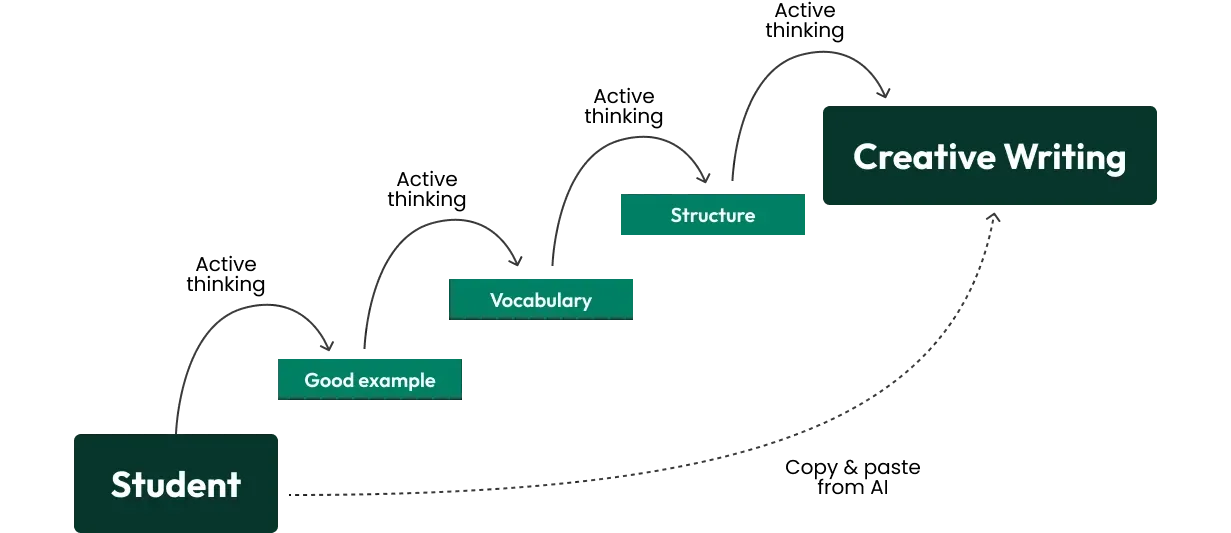
In the classroom, teachers work step-by-step towards specific learning goals using 'scaffolds'—temporary supports like glossaries, structure sheets, or examples. The pedagogical intent is to provide heavy support initially and gradually remove it until the student achieves independence.

However, Robbe identifies a critical issue: uncontrolled AI assistance short-circuits this deliberate structure. When a student uses a chatbot to generate text and simply copy-pastes the result, they aren't just cheating; they are bypassing the essential cognitive struggle required for mastery. This turns AI into a shortcut rather than a support tool. Robbe sought a solution that moves beyond the binary choice of 'ban it' or 'ignore it.' He needed a way to regain control and insight into the learning process—formulating clear agreements, limiting distractions, and making the writing journey visible—without reverting to the limitations of pen and paper.

When AI short-circuits the scaffold

The Framework

A 4-level guide for intentional AI

To move beyond a binary 'ban or allow' mindset, Robbe utilizes a clear 4-level framework. This ensures that AI is only introduced when it serves the specific learning objective of the assignment, rather than dictating it.

Level 0: No AI

Reserved for foundational skills where external assistance would undermine the core competency. Here, the focus is entirely on the student's unassisted output.

Level 1: AI for planning

AI is permitted only at the start of the process—for brainstorming or generating checklists. The actual writing, processing, and synthesis remain the student's sole responsibility.

Level 2: AI for collaboration

AI is introduced mid-process, specifically for formative feedback or targeted suggestions. The student must still initiate the work and finalize the output independently.

Level 3: AI as a partner

For advanced tasks, broad AI support is allowed throughout the workflow. However, this requires total transparency: students must be able to justify what is theirs and what is machine-generated.

The Solution

Enforcing the framework with DidactLabs

Theory needs a tool to become practice. Robbe uses DidactLabs because it is the only platform that allows him to 'program' his framework directly into the assignment, acting as a central control room for the writing process.

Two types of prompts

DidactLabs allows Robbe to centralize control through two distinct layers of instructions:

  • The Student Instructions explicitly outline assignment criteria and AI-use instructions—preventative measures that set clear boundaries on what is permitted.
  • The System Prompt dictates exactly how the AI behaves—defining its tone, response length, and specific refusal mechanisms. This ensures the built-in assistant adheres to the same pedagogical rules as the teacher, acting as a 'conscious scaffold' that supports the learning objective rather than a shortcut that hinders it.

Forensic process visibility

Instead of relying on opaque, error-prone AI detectors, Robbe uses DidactLabs to see the complete picture of student work. The platform reveals multiple layers of insight:

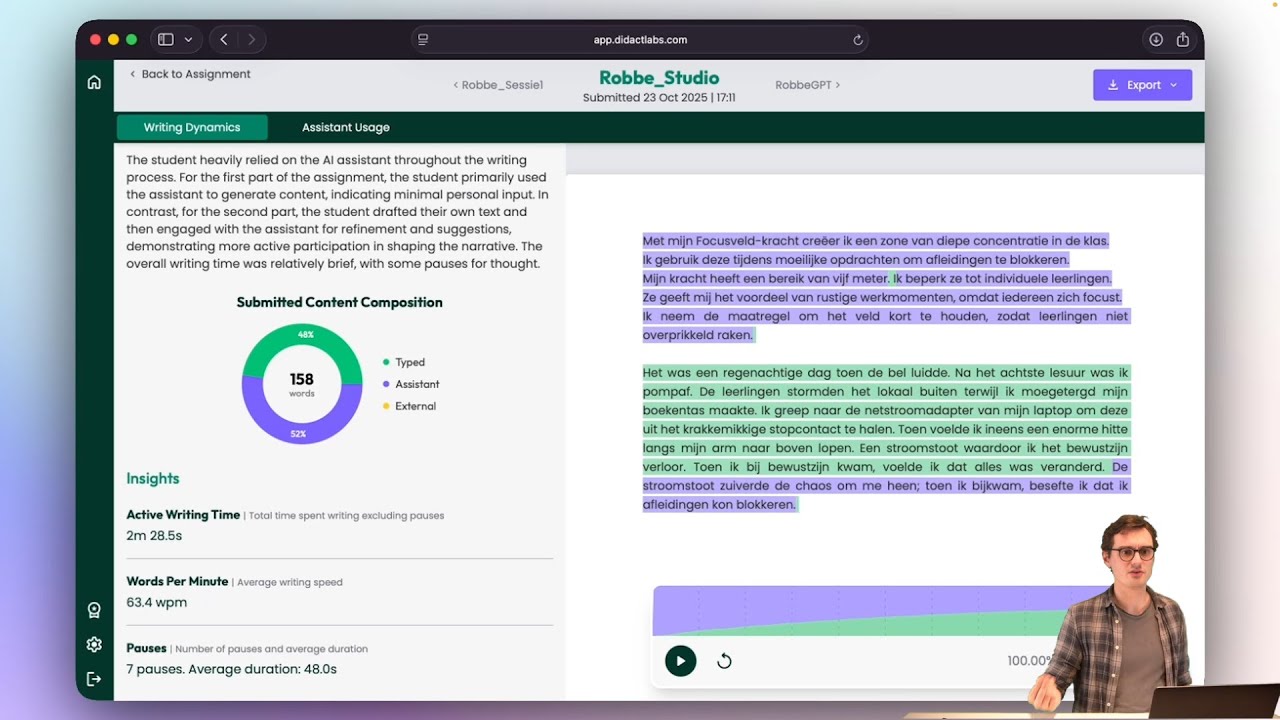
  • Writing Dynamics: The complete revision timeline shows how the text evolved—what was typed by the student, what was generated by AI, and what was pasted from external sources. Extracted features such as words per minute, pause duration, and copy-paste events expose unnatural patterns—if text appears instantly or typing rhythm is suspiciously consistent, the dashboard reveals it immediately.
  • AI Assistant Usage: Every interaction with the built-in AI is logged and visible. Robbe can see exactly what questions students asked, which suggestions they accepted or rejected, and how they integrated AI feedback into their work.
This forensic visibility shifts the conversation from accusation ('Did you use AI?') to evidence-based coaching ('I see you used AI here—let's talk about how that helped or hindered your learning'). It transforms assessment from a guessing game into a transparent dialogue about the learning process.

Focus via Safe Exam Browser (SEB)

To ensure the integrity of the 'scaffold,' Robbe combines DidactLabs with the Safe Exam Browser. This locks the student into the assignment environment, preventing them from tab-switching to unrestricted chatbots like ChatGPT. It keeps the student focused on the task and ensures they only use the study-tuned AI assistant provided within DidactLabs.

The Result

Valid writing assessment in the AI era

DidactLabs gives us an answer to the AI question that isn't just 'return to pen and paper.' We don't just see the final product; we see the struggle, the edits, and the actual thinking process. It allows us to evaluate the student's journey, not just their destination.

Robbe Wulgaert, Teacher & EdTech Coordinator at Sint-Lievenscollege Gent
Robbe Wulgaert

About Robbe Wulgaert

Robbe Wulgaert is a teacher of programming, artificial intelligence, and Design Thinking based in Ghent, Belgium. He teaches at Sint-Lievenscollege and the Center for Continuing Education at the University of Antwerp. When not in the classroom, he can often be found writing as an AI researcher in a Ghent coffee bar. He is also the author of the book AI in de klas - Praktische gids voor onderwijsprofessionals (AI in the Classroom - A Practical Guide for Education Professionals).

Passionate about education in programming, computational thinking, and AI literacy, Robbe shares a wealth of practical teaching materials on his website. He is also available to present his work and insights in person at schools and organizations.

Take control of AI in your classroom today

Join the growing community of educators preparing students for an AI-powered future while maintaining academic integrity.
Start in minutes, for free.